Most small business owners ordering custom packaging for the first time are coming from somewhere else entirely – they’ve built a product, found some early customers, and now realise the box it ships in is part of the experience too. It’s an exciting stage to be at. It’s also a stage where a few avoidable mistakes can cost real money.
Why Packaging Matters More Than You Might Expect
For e-commerce and direct-to-consumer brands particularly, packaging has become part of the product itself. The unboxing experience shapes how a customer feels about a purchase before they’ve even used what’s inside. A generic brown box says one thing. Branded packaging with some thought put into it says another.
This isn’t about over-spending on packaging for its own sake. It’s about recognising that for a lot of small businesses, packaging is doing real marketing work – building brand recognition, encouraging repeat purchases, and occasionally getting unboxed on social media, which is free advertising you don’t want to waste on something forgettable.
Minimum Order Quantities: The First Thing That Surprises People
This is where a lot of first-time packaging buyers hit an unexpected wall. Unlike business cards or flyers, where small runs are straightforward, custom packaging often involves minimum order quantities (MOQs) that are higher than people anticipate.
Why MOQs exist for packaging: Custom packaging usually requires a print plate or die to be made specifically for your design and box shape. That setup cost is fixed regardless of whether you order 100 units or 10,000. Spreading that cost across a larger run brings the per-unit price down to something reasonable. Below a certain quantity, the per-unit cost becomes uneconomical for both the customer and the printer.
Typical MOQ ranges: This varies depending on the type of packaging and the printing method, but as a general guide:
- Simple stock boxes with a printed label or sticker: very low MOQs, sometimes as low as 50-100 units
- Custom-printed boxes (digital printing): often starting around 100-250 units
- Custom-printed boxes (offset/litho printing, used for larger runs): typically 500-1,000+ units, with better economics at higher volumes
- Custom die-cut shapes or unusual box structures: higher MOQs due to the die-cutting tool cost
What this means for planning: If you’re a genuinely new business unsure of your sales volume, it’s worth discussing options that bridge the gap – digital printing runs at a lower MOQ while you validate demand, then moving to offset printing once you have confidence in your volumes and want a lower unit cost.
Material Options and What They’re Suited For
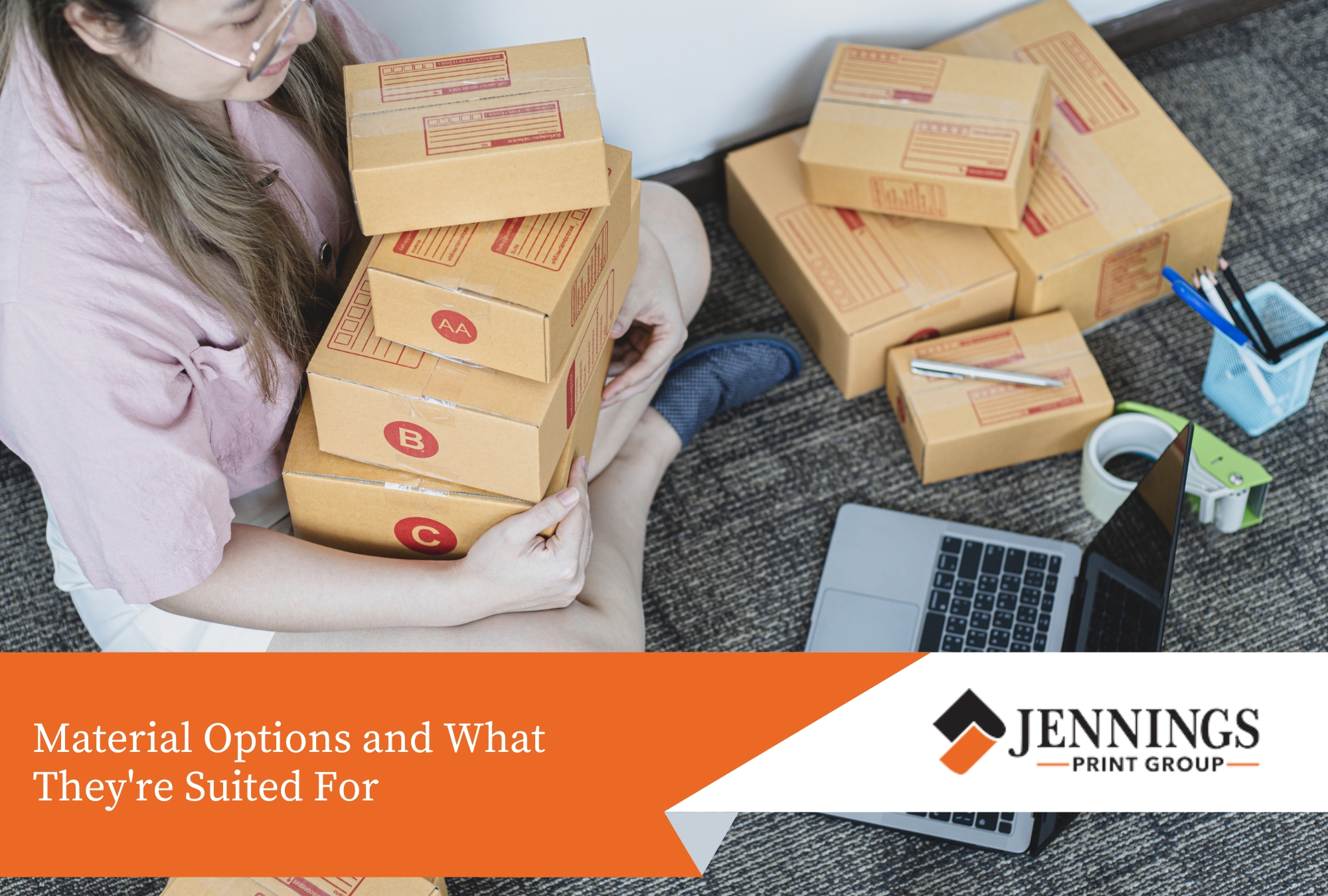
The material you choose affects cost, durability, sustainability positioning, and how your product is actually protected in transit.
Corrugated Cardboard
The standard choice for shipping boxes and most retail packaging that needs to handle some rough treatment. Corrugated comes in different flute sizes (the wave-shaped inner layer that gives it strength) – generally, a finer flute gives a smoother printing surface and a more refined look, while a heavier flute offers more cushioning and strength for fragile or heavier items.
Kraft Board
Popular for retail boxes, mailers, and product packaging where a natural, slightly rustic aesthetic suits the brand. Kraft is often used unbleached, giving that recognisable brown-paper look, though it can also be printed on directly with strong colour reproduction. It’s a common choice for brands leaning into sustainability messaging, since kraft is widely recyclable and often made from recycled content.
Rigid Board
Used for premium packaging – think of the box a higher-end skincare product or a piece of jewellery arrives in. Rigid board doesn’t fold flat like corrugated or standard card; it’s built up to create a sturdy, often luxurious box that signals a higher price point. It costs considerably more than corrugated or kraft, and the MOQs and lead times tend to be longer due to the more involved construction process.
Folding Cartons
The lightweight printed boxes used for retail products like cosmetics, food items, and small electronics. These are typically die-cut and folded flat for shipping, then assembled at the point of packing. They offer strong branding opportunities since the entire surface can be printed, and they work well for products that need shelf presence in a retail environment.
Branding Considerations Worth Thinking Through Early
Decide what story the packaging needs to tell. Some brands want packaging that disappears into the background, letting the product itself be the focus. Others want the packaging to be a visible part of the brand experience, particularly if customers are likely to photograph or share their unboxing. Knowing which camp you’re in shapes every other decision.
Printed vs. labelled. Full custom printing directly onto the box gives the most cohesive branded look but comes with higher MOQs and setup costs. A simpler approach – a plain stock box with a branded sticker or label – is more flexible for lower volumes and easier to update if your branding changes. Many growing businesses start with labels and move to full custom printing once volume justifies it.
Think about the inside, not just the outside. Tissue paper, branded tape, inserts, and thank-you cards are lower-cost ways to add a branded touch without committing to full custom box printing. For businesses not yet ready for the MOQs of custom boxes, this is a practical middle ground.
Consider how the packaging performs functionally, not just visually. A beautifully designed box that doesn’t protect the product properly, or that’s awkward to pack and seal, creates real problems once you’re shipping at volume. Test your packaging with your actual product before committing to a large print run.
Sustainability messaging needs to match the substance. If sustainability is part of your brand story, make sure the packaging choices back that up – recyclable materials, minimal plastic, FSC-certified board. Customers increasingly notice when sustainable messaging doesn’t match the actual packaging.
Lead Times: Plan Further Ahead Than You Think
This is the second most common surprise for first-time packaging buyers, after MOQs.
Custom packaging lead times are typically longer than standard print products because of the additional steps involved – design proofing, die or plate creation, sample approval, and then the print run itself. As a general guide:
- Simple stock packaging with labels: Can often be turned around in 1-2 weeks once artwork is finalised
- Custom-printed boxes (digital, lower volume): Typically 2-4 weeks
- Custom-printed boxes (offset, larger volume): Often 4-8 weeks, depending on complexity and current production schedules
- Rigid or specialty packaging: Can extend to 6-10 weeks given the more complex construction
These timelines assume your artwork is finalised and approved before the print run begins. Revisions and approval delays add directly to the timeline, so building in buffer time for proofing and sign-off is worth doing rather than assuming the quoted lead time starts the day you place the order.
Plan for seasonal demand early. If your packaging needs are tied to a peak period – Christmas, a product launch, a seasonal promotion – place your order well ahead of that period. Printers everywhere see a surge in packaging orders heading into Q4, and lead times stretch accordingly. Ordering in August for a November launch is a safer bet than ordering in October.
A Practical Path for First-Time Packaging Buyers
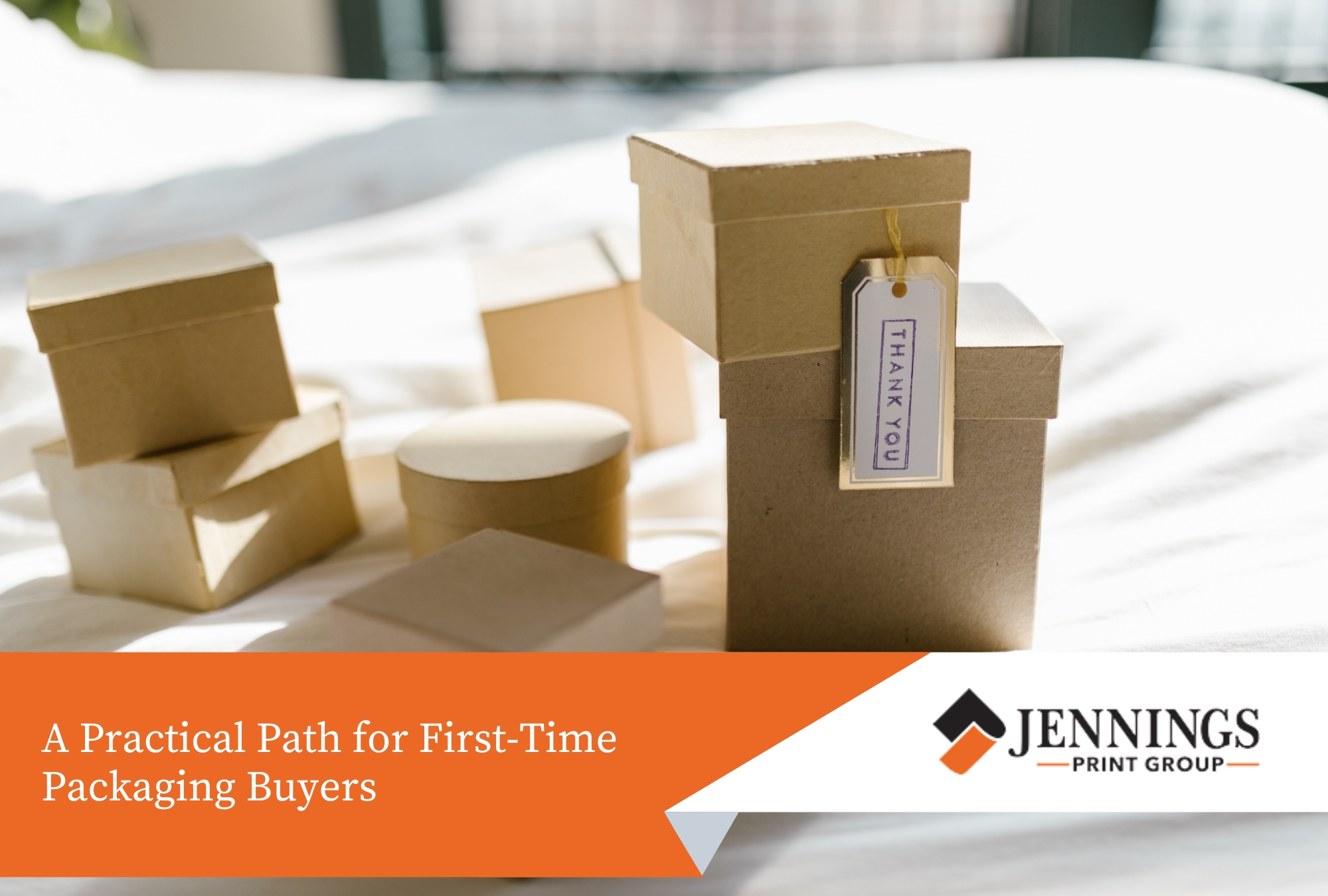
If you’re starting out and don’t want to overcommit before you’ve validated demand, a sensible sequence looks something like this:
- Start with a stock box and a branded label or sticker. Low MOQ, fast turnaround, gives your product a branded presence without a large upfront commitment.
- Test the packaging with real shipments. Make sure it protects the product, looks good arriving at someone’s door, and holds up in transit.
- Move to custom-printed packaging once volume justifies it. At this point the MOQs and setup costs make more sense, and you’ll have a clearer sense of your actual ongoing volume to plan around.
- Revisit material and finish choices as the brand develops. What worked at the very beginning might not reflect where the brand sits a year or two later. Packaging can evolve alongside the business.
This staged approach avoids tying up cash in a large print run before you’re confident in your numbers, while still giving your product a professional, branded presence from day one.
Getting Started
Custom packaging doesn’t need to be complicated, but it does benefit from going in with realistic expectations about quantities, materials, and timing. Getting a proper understanding of MOQs and lead times before you commit avoids the two most common frustrations first-time buyers run into.
If you’re planning your first packaging run and want to talk through what makes sense for your product, your volume, and your budget, it’s worth having that conversation before finalising artwork. Browse the full range of packaging and print products available, or get in touch with the team at Jennings Print to discuss what’s realistic for your business.