A safety sign is a sign used at a workplace to control behaviour, warn of a hazard, or show where emergency and fire equipment is. In Australia the design rules come from AS 1319-1994 (R2018), Safety signs for the occupational environment. It sorts signs into four groups and seven sign types, each with a fixed colour and shape so the message reads before the words do. The standard covers colour, shape, layout, symbols, lettering and placement. It doesn’t tell you where the law requires a sign, which is a separate question, and this guide covers both.
What is AS 1319?
AS 1319-1994 (R2018), Safety signs for the occupational environment, is the Australian Standard that sets how workplace safety signs are designed and used. It covers colour, shape, layout, wording, symbols and siting. Standards Australia reconfirmed the 1994 fourth edition on 21 September 2018, so it remains the current version.
Reconfirmation means the content was reviewed and found still valid without change, which is why a standard written in 1994 is still the reference point in 2026. You can confirm its status on the Standards Australia store listing for AS 1319.
Two things the standard deliberately leaves out are worth knowing up front. It does not cover illuminated EXIT signs inside buildings, which sit under AS 2293.1. And it does not set a required material or a nominal sign size. What it gives you instead is a legibility rule based on viewing distance, covered further down.
Is AS 1319 a law?
No. AS 1319 is a standard, not legislation. The legal duty comes from the Work Health and Safety Act 2011 and the WHS Regulation in your state or territory, which require risks to be managed so far as is reasonably practicable. Signs are one of those controls.
In New South Wales the regulation was remade recently. The Work Health and Safety Regulation 2025 commenced on 22 August 2025 and replaced the 2017 regulation, and its provisions are now called sections rather than clauses. If you’re working from a signage checklist that cites the 2017 clause numbers, it’s out of date. SafeWork NSW has the details.
When does the law require a safety sign?
WHS law rarely names a specific sign. Most of the time the duty is to manage the risk, and a sign is one way of doing it. A few situations are different, and the regulation spells the signage out. Confined spaces, hazardous chemical storage and asbestos removal all carry their own requirements.
Using the NSW WHS Regulation 2025 section numbers:
- Confined spaces. Section 68 requires signage at the entry to a confined space that identifies it and tells workers not to enter without a confined space entry permit.
- Hazardous chemicals. Sections 349 and 350 cover outer warning placards and placards where chemicals are held above the placard quantity.
- Asbestos removal. Section 469 requires signage and barricades around an asbestos removal area.
Other states and territories have equivalent provisions under their own WHS Regulations, with different numbering. Victoria and Western Australia run their own frameworks. Check the rule that applies where the work is happening rather than assuming the NSW numbering travels.
Beyond those, the signs you put up come out of your own risk assessment. Forklift traffic, hearing protection zones, live electrical panels, chemical stores, site entries and first aid points are the usual ones.
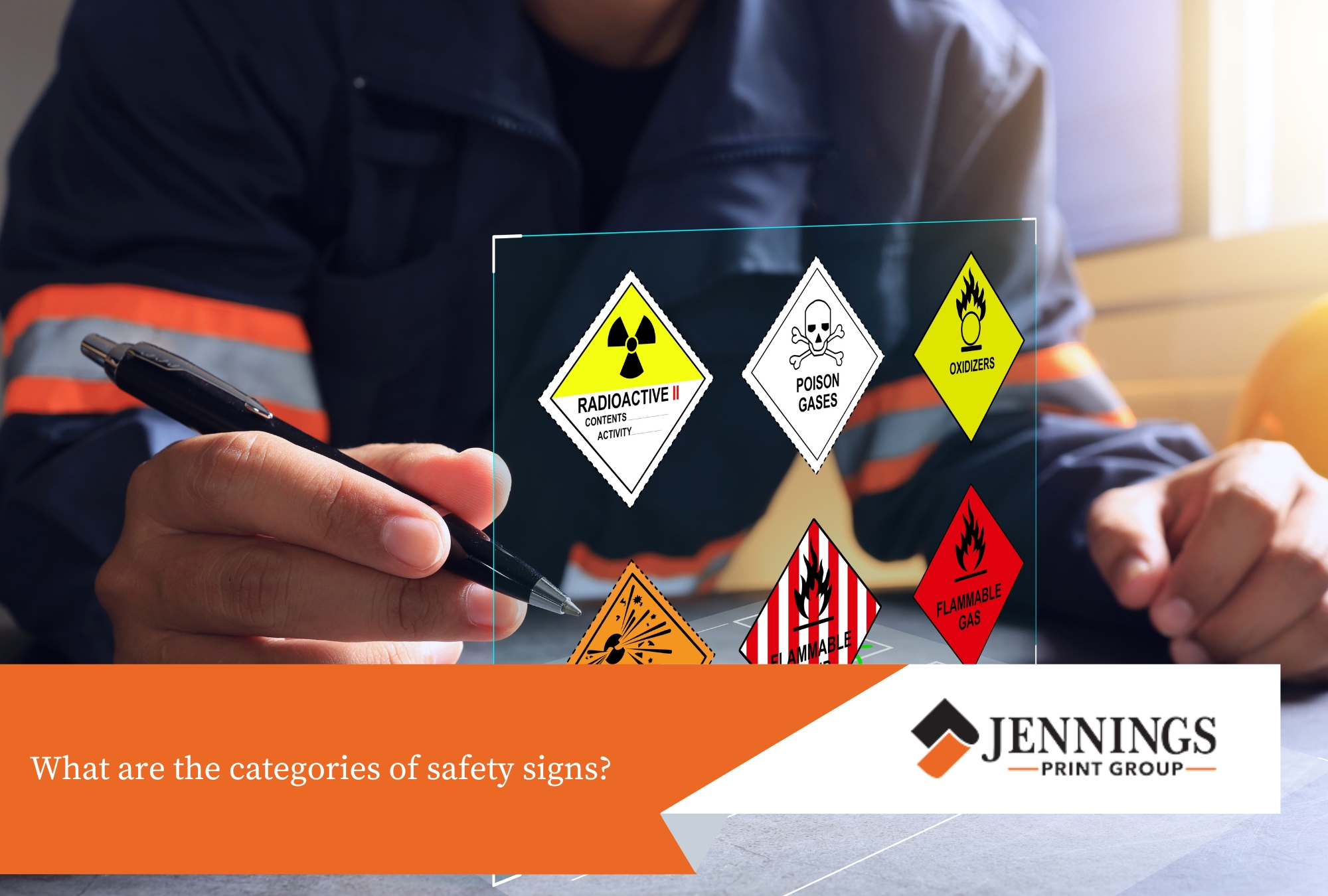
What are the categories of safety signs?
AS 1319 puts signs into four groups: regulatory, hazard, emergency information and fire. Regulatory splits into prohibition, mandatory and restriction signs. Hazard splits into danger and warning signs. That gives four groups and seven sign types, which is why some guides say four categories and others say seven. Both counts describe the same system.
Prohibition signs
Prohibition signs say an activity isn’t permitted. The shape is a red circle with a red diagonal slash through it, over a black pictogram showing what’s prohibited. Background white, text black. No Smoking is the one everybody knows.
Mandatory signs
Mandatory signs say an action must be carried out. The shape is a solid blue circle with a white pictogram inside it, on a white background with black text. Hearing Protection Must Be Worn and Safety Glasses Must Be Worn are typical.
Restriction signs
Restriction signs put a numerical or defined limit on an activity. The shape is a red circle with no slash, with the limit shown inside it. Speed limits on a site road are the common example. AS 1319 doesn’t publish specific restriction signs itself and points to AS 1742.1 for speed limit signs.
Danger signs
Danger signs warn of a hazard that is likely to be life threatening. The format is the word DANGER in white on a red oval inside a black rectangle, usually as a header panel above black text on white. Typical wording is HIGH VOLTAGE or CONFINED SPACE.
Danger signs carry their message in words, not pictograms. If a hazard can kill, it gets a danger sign, not a warning sign. Mixing the two up is the most common mistake on Australian sites.
Warning signs
Warning signs cover a hazard that isn’t likely to be life threatening. The shape is a black triangle on a yellow background, with a black pictogram inside the triangle and black text below. Forklifts Operating and Slippery Surface are typical.
Emergency information signs
Emergency information signs show where emergency facilities are, or point the way to them. Green background, white symbol and white text. First aid, safety showers, eyewash stations and assembly points all sit in this group.
Fire signs
Fire signs show where fire alarms and firefighting equipment are. Red background, white symbol and white text. Extinguisher, hose reel, fire blanket and fire alarm signs are the usual set. Fire is its own group under AS 1319, separate from emergency information, even though both are location signs.
Safety sign colours and shapes: the quick reference
The fastest way to check a sign is to look at colour and shape before you read the wording. If a sign’s colour and shape don’t match its message, the sign is wrong no matter how good the artwork is.
| Sign type | Colour | Shape | What it means | Example wording |
| Prohibition | Red circle and slash, black symbol, white background | Circle | You must not do this | NO SMOKING |
| Mandatory | Blue circle, white symbol, white background | Circle | You must do this | HEARING PROTECTION MUST BE WORN |
| Restriction | Red circle, no slash, black legend | Circle | A numerical or defined limit applies | 10 KM/H |
| Danger | Red oval in a black rectangle, white DANGER text | Rectangle with header panel | Life threatening hazard | DANGER HIGH VOLTAGE |
| Warning | Yellow background, black triangle and symbol | Triangle on rectangle | Hazard requiring caution | FORKLIFTS OPERATING |
| Emergency information | Green background, white symbol and text | Rectangle or square | Where to find emergency facilities | FIRST AID |
| Fire | Red background, white symbol and text | Rectangle or square | Where to find fire equipment | FIRE EXTINGUISHER |
Where should safety signs be placed?
AS 1319 asks that signs sit close to the observer’s line of sight in the vertical plane, against a contrasting background, where stacked materials and other obstructions can’t hide them. It doesn’t set a fixed mounting height. Placement is a judgement about sightlines, not a measurement.
A few practical rules follow from that:
- Put the sign where there’s still time to act on it. A danger sign at the hazard itself is too late if the reader needed to stop ten metres earlier.
- Prohibition and mandatory signs belong at the entry point to the area they govern, not inside it.
- Keep signs lit. A sign nobody can read at 5am in winter isn’t doing anything.
- Don’t crowd them. A wall of twenty signs gets read as wallpaper. If every sign is critical, none of them is.
- Maintain them. Faded, cracked or dirty signs are a liability, and replacing them is cheaper than defending them.
What size should a safety sign be?
AS 1319 sets size by viewing distance, not by a fixed dimension. Where lighting is good, symbols should be at least 15 mm high per metre of viewing distance and uppercase text at least 5 mm per metre. Increase both by at least 50 per cent in poor conditions.
Worked through, that gives you a table you can hand to a printer:
| Viewing distance | Minimum symbol height | Minimum uppercase text | Poor conditions, symbol | Poor conditions, text |
| 5 m | 75 mm | 25 mm | 115 mm | 40 mm |
| 10 m | 150 mm | 50 mm | 225 mm | 75 mm |
| 15 m | 225 mm | 75 mm | 340 mm | 115 mm |
| 20 m | 300 mm | 100 mm | 450 mm | 150 mm |
| 25 m | 375 mm | 125 mm | 565 mm | 190 mm |
Poor condition figures are rounded up. Work backwards from the furthest point a person needs to read the sign from, not from the size of the panel you’d like to buy. The WorkSafe ACT guidance on signage sets out the same legibility rule.
Fonts and lettering on safety signs
AS 1319 draws its lettering from AS 1744, Standard alphabets for road signs, the same family used on Australian road signage. In practice that means a plain sans serif, even stroke weight, generous letter spacing and no decorative faces. Legibility at distance is the only test that matters.
We’ve covered the detail separately in what fonts are best for readable signs, including the all caps question and what works at different sign sizes.
Which sign material suits which environment?
Material doesn’t come from the standard. It comes from where the sign is going, how long it needs to last and what’s going to hit it. Corflute suits short-term outdoor use, Alupanel suits permanent external signs, and self-adhesive vinyl suits plant, doors and painted surfaces.
| Material | Best for | Worth knowing |
| Corflute | Site signage, temporary works, construction entries | Light, cheap to replace, fluted structure can crack at fixing points over time |
| Alupanel and aluminium composite | Permanent external signage, site entry boards, gates | Rigid, holds flat, the usual choice where a sign stays up for years |
| PVC and rigid plastic | Indoor plant rooms, chemical stores, washdown areas | Handles moisture well, less UV stable than metal composite |
| Self-adhesive external vinyl | Machinery, switchboards, doors, vehicles | Conforms to curves, surface prep matters more than the sticker |
| Reflective materials | Low light areas, night work, vehicle and traffic signage | Needs headlights or a torch to do its job, not a substitute for lighting |
Two Australian conditions deserve more weight than they usually get. Coastal salt air near Newcastle and the Hunter coastline attacks fixings and substrate edges, so fixing choice matters as much as panel choice. And UV load on an unshaded northern or western elevation will fade a sign faster than any other factor, which is why ink and laminate choice is part of the specification, not an upsell.
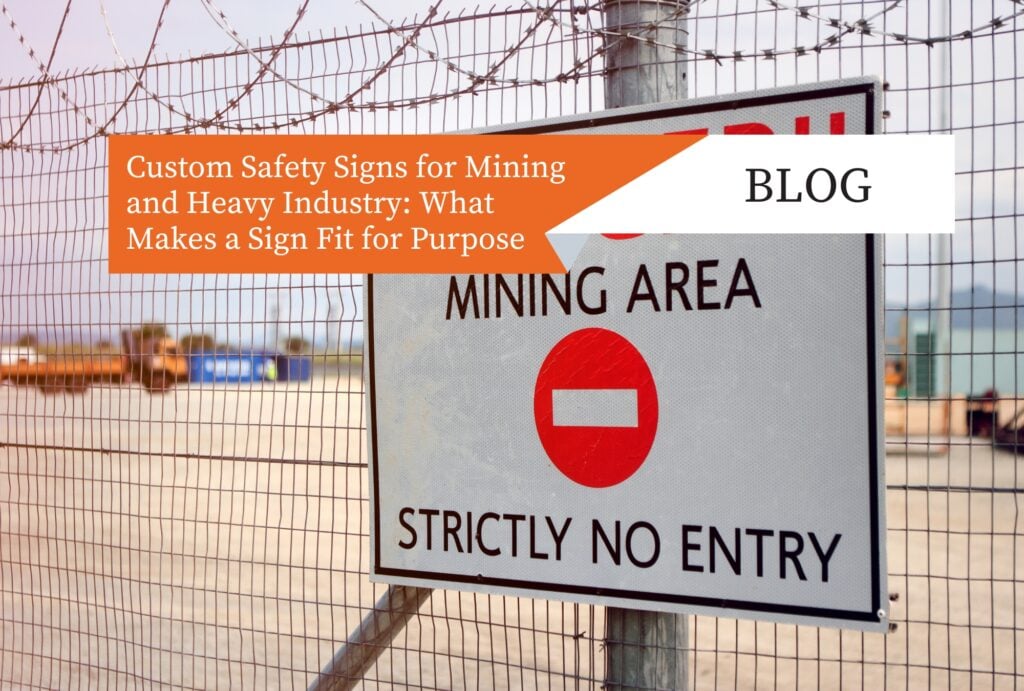
If you’re specifying signs for mining or heavy industry, we’ve written separately about what makes a sign fit for purpose in those conditions, including dust, abrasion, chemical exposure and vibration.
Related standards worth knowing
AS 1319 isn’t the only standard that touches signage. Fire equipment, pipework and building exits all have their own, and getting a sign right under AS 1319 doesn’t mean it’s right under the others. The five below come up most often on Australian sites.
- AS 2444-2001 (R2021), Portable fire extinguishers and fire blankets: selection and location, covers extinguisher and fire blanket location signs and where they go. Status on the Standards Australia store.
- AS 1345-1995 (R2018), Identification of the contents of pipes, conduits and ducts, covers pipe marking and colour coding.
- AS 2293.1 covers illuminated EXIT signs inside buildings, which AS 1319 excludes from its own scope.
- AS 1744:2015, Standard alphabets for road signs, is the lettering reference AS 1319 draws on.
- Dangerous goods placards and GHS labelling for hazardous chemicals follow the ADG Code and the WHS Regulation, not AS 1319.
Frequently asked questions
How many types of safety signs are there in Australia?
Seven, grouped into four categories. The groups are regulatory, hazard, emergency information and fire. The regulation covers prohibition, mandatory and restriction signs. Hazard covers danger and warning signs. Guides that say four and guides that say seven are both describing the same AS 1319 structure.
Are safety signs a legal requirement in Australia?
Signs are a control, and WHS law requires risks to be managed so far as is reasonably practicable. Some situations have explicit requirements, including confined spaces, hazardous chemical placards and asbestos removal areas. Beyond those, your risk assessment decides what goes up.
What colour is a danger sign in Australia?
A danger sign uses the word DANGER in white on a red oval, inside a black rectangle, normally as a header panel above black text on a white background. Red on its own is also used for prohibition and fire signs, so the shape matters as much as the colour.
Does AS 1319 say how big a safety sign has to be?
Not as a fixed size. It sets legibility by viewing distance: symbols at least 15 mm per metre and uppercase text at least 5 mm per metre, increased by at least 50 per cent in poor lighting or viewing conditions. You size the panel around the text it has to carry.
Can I print my own safety signs?
Yes, provided the design follows the AS 1319 colours, shapes and layouts, and the material suits the environment. Custom wording is common and often necessary, because site-specific hazards rarely match a generic catalogue sign.
Getting your site signage right
Most signage problems we see aren’t design problems. They’re the wrong material for the location, text too small for the sightline, or a generic sign standing in for a site-specific hazard. All three are fixable at the quoting stage.
Jennings Print produces custom safety products and site signage on external vinyl, plastic, corflute and Alupanel, along with reflective signage, safety tags, permits and pre-start books. We’re a commercial printer in Newcastle working with Hunter industry, construction and civil operators.
Send us your sign list and site conditions and we’ll quote the right substrate for each location. Request a quote or call 02 4933 5735.