A docket book is a bound book of carbon-copy forms used to record work on site as it happens, with one copy for the client and one that stays in the book. On an earthmoving or plant hire job the docket needs ten things: date, site or job number, plant type, registration or fleet number, operator name, start and finish times, total hours, wet or dry hire, materials carted, and a client signature against a sequential docket number. Get those right and the docket holds up when someone queries the invoice three months later. Get them wrong and you’re arguing from memory.
What is an NCR docket book?
NCR stands for no carbon required. It’s carbonless copy paper, where coated sheets transfer the writing to the pages underneath without a sheet of carbon in between. Duplicate means two parts, triplicate means three. The top copy is the original and the ones below it are the file copies.
Who gets which copy depends on how you run the job. The usual split on a civil site is:
- Duplicate. Top copy to the client or site supervisor, second copy stays bound in the book for the office.
- Triplicate. Top copy to the client, second to the office for invoicing, third stays in the book as the permanent record.
Colour-coding the parts saves arguments. White, yellow then pink is the order most operators already recognise.
What information goes on an earthmoving docket?
Every field on a docket exists because somebody once disputed it. The list below covers plant hire and earthmoving work. Leave enough room on each line to write with a gloved hand, because a field nobody can fill in on site stays blank.
- Date and day. Weekend and public holiday rates hang off this.
- Site or job number. Matches the docket to the purchase order and the invoice.
- Client name and contact. Who ordered the work, not just the company.
- Plant type and size. 20 tonne excavator, not “excavator”.
- Registration or fleet number. Identifies the exact machine for servicing and for disputes.
- Operator name. Also feeds your timesheets.
- Start, finish and break times. Not just a total. The breakdown is what survives a query.
- Total hours, with travel or float separate. Mobilisation is usually charged differently.
- Wet or dry hire. Worth its own tick box.
- Materials carted, type and quantity. In the unit you invoice in.
- Standby or delay time, with a reason. The most disputed line on any docket.
- Fuel supplied, and by whom.
- Client signature and printed name. A signature nobody can read is worth less than a printed name beside it.
- Sequential docket number. Pre-printed, not handwritten.
Wet hire or dry hire?
Wet hire means the machine comes with an operator. Dry hire means the machine goes out on its own and the client supplies the operator. The docket changes with it, because wet hire is billed on operating hours and dry hire is usually billed on a day or week rate with a condition report attached.
A dry hire docket needs fields a wet hire docket doesn’t: hour meter reading out and back, fuel level out and back, a damage and condition section, and a space for attachments sent with the machine. A wet hire docket leans harder on times, breaks and standby.
If you do both, print one book with a wet or dry tick box at the top and the dry hire fields in a boxed section underneath. One book beats two, because the wrong book is always the one in the ute.
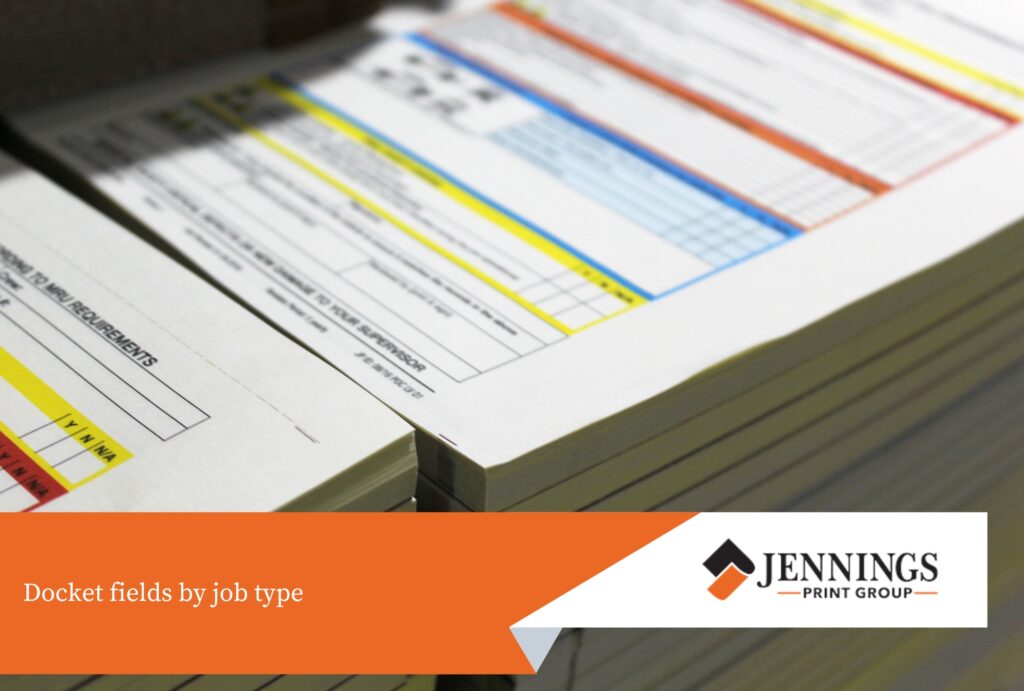
Docket fields by job type
Earthmoving, haulage and general civil work need different dockets, even on the same site. The table below sets out which fields each one needs, and it’s the fastest way to work out what belongs in your book before you brief a printer. Build from the column that matches your work.
| Field | Earthmoving and plant hire | Haulage and tipper | General civil |
| Date and job number | Yes | Yes | Yes |
| Plant type and fleet number | Yes | Truck and trailer rego | Yes |
| Operator or driver name | Yes | Yes | Yes |
| Start, finish, break times | Yes | Yes | Yes |
| Total hours | Yes | Sometimes, often paid per load | Yes |
| Loads carted | If carting | Yes, the core field | Sometimes |
| Material type and source | If carting | Yes | Yes |
| Tonnes or cubic metres | If carting | Yes | Sometimes |
| Pick-up and drop-off point | No | Yes | Sometimes |
| Weighbridge docket number | No | Yes | Sometimes |
| Wet or dry hire | Yes | No | No |
| Hour meter in and out | Dry hire only | No | No |
| Standby or delay time | Yes | Yes | Yes |
| Labour, by trade and hours | No | No | Yes |
| Materials used on site | No | No | Yes |
| Client signature | Yes | Yes | Yes |
Duplicate or triplicate?
Triplicate, if the office and the yard are different people. Two copies work when the same person writes the docket and raises the invoice. Three copies work when the docket has to live in the book, sit in an invoicing pile, and go to the client, which is most civil and plant hire operations.
Quad books earn their place in one situation: when a subcontractor, a principal contractor and a client all need a copy. Outside that, the extra part makes the bottom copy hard to read.
Why sequential numbering matters
A sequential number turns a pile of paper into an audit trail. Run the numbers across the whole order rather than restarting at one in each book, and you can tell at a glance which dockets are missing, which book they came from and roughly when they were written.
That matters in three places. It reconciles invoicing, because every number is either invoiced, voided or outstanding. It settles disputes, because a client claiming they never got docket 4417 has to explain 4416 and 4418. And it flags problems early, because a run of missing numbers from one crew is worth asking about.
Void dockets stay in the book. Write VOID across them and leave them bound in, because a gap in the sequence is a question you’ll have to answer later.
Sizes, binding and covers
A5 is the practical size for a ute or a cab. A4 gives you room for a materials table or a condition report and suits an office or a site shed. A3 suits pre-start and plant status books where the form needs more fields than a docket does.
The finishing is what decides whether the book survives the job:
- Hard cover with a wraparound writing guard. The guard slips behind the set you’re writing on so you don’t mark the pages underneath, and it folds around the book in the cab.
- Perforated tear-out. The client’s copy comes away cleanly and the rest stays bound.
- Glued and taped head binding. Stapled books come apart in a toolbox.
- A stiff backing board. You’re writing on a tailgate, not a desk.
Jennings Print produces custom docket books in A4 and A5 on NCR paper, duplicate or triplicate, hard covered, numbered, perforated and with a wraparound writing guard. Safety books, pre-start checklists and plant status report books run A5 to A3 and go up to quad.
How long do you have to keep dockets?
Dockets are business records, so the rules that cover invoices and timesheets cover them too. The ATO generally requires business records to be kept for five years from when the record was made or the transaction completed, whichever is later. Fair Work requires time and wages records to be kept for seven years.
That makes the file copy in the book the part that matters most. Store finished books in date order with the number range on the spine.
If you’re carting on public roads, a tipper docket often doubles as part of your mass and load record. Record keeping sits inside the Chain of Responsibility duties under the Heavy Vehicle National Law, which covers ten defined parties including operators, loaders, consignors and consignees. Check what applies with the NHVR rather than assuming your docket covers it, and remember a driver work diary is a separate legal record that a docket book doesn’t replace.
What to send your printer
A printer needs five things: the fields in the order you fill them in, the size and number of parts, sets per book and quantity, your branding and contact details, and the number your last book finished on. Bring the book you use now, even as a marked-up photo.
Terms on the reverse of the client copy are worth doing once, properly. Payment terms, standby charges and a line saying a signature acknowledges the hours worked all belong there.
Frequently asked questions
What is the difference between NCR and carbon paper?
Carbon paper is a separate black sheet placed between pages. NCR, or no carbon required, has the transfer coating built into the paper itself. NCR is cleaner, thinner and what almost every docket book printed in Australia uses now.
Can you print docket books with our existing numbering?
Yes. Tell your printer the number your last book finished on and the new order continues from there. It’s worth doing, because restarting at one creates duplicate numbers in your records.
How many sets should a docket book have?
Fifty sets is the common size and suits most crews for a month or two. Go smaller if the book lives in a cab and takes a beating, larger if it stays in the site office.
Do digital dockets replace paper on site?
Plenty of operators run both. Paper keeps working when there’s no signal in a cut, when the client wants something to sign on the spot, and when a phone is flat. Plenty of operators use the paper docket as the on-site record and key it into the system later.
Getting your docket books right
The books that work are built around how your crew fills them in on site. Field order, size and number of parts matter more than anything else on the order.
Jennings Print has been printing docket books for Hunter operators for over 45 years, along with corporate stationery and safety books, permits and pre-start checklists. We’re a commercial printer serving Maitland and the wider Hunter, and we’ve covered why customised docket books beat generic ones separately.
Send through your current docket and we’ll quote the rebuild. Request a quote or call 02 4933 5735.